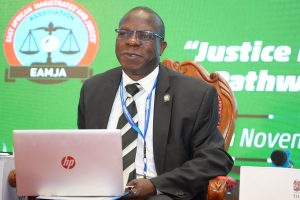



Panels highlight critical issues on multi-door approaches to justice at the EAMJA Conference
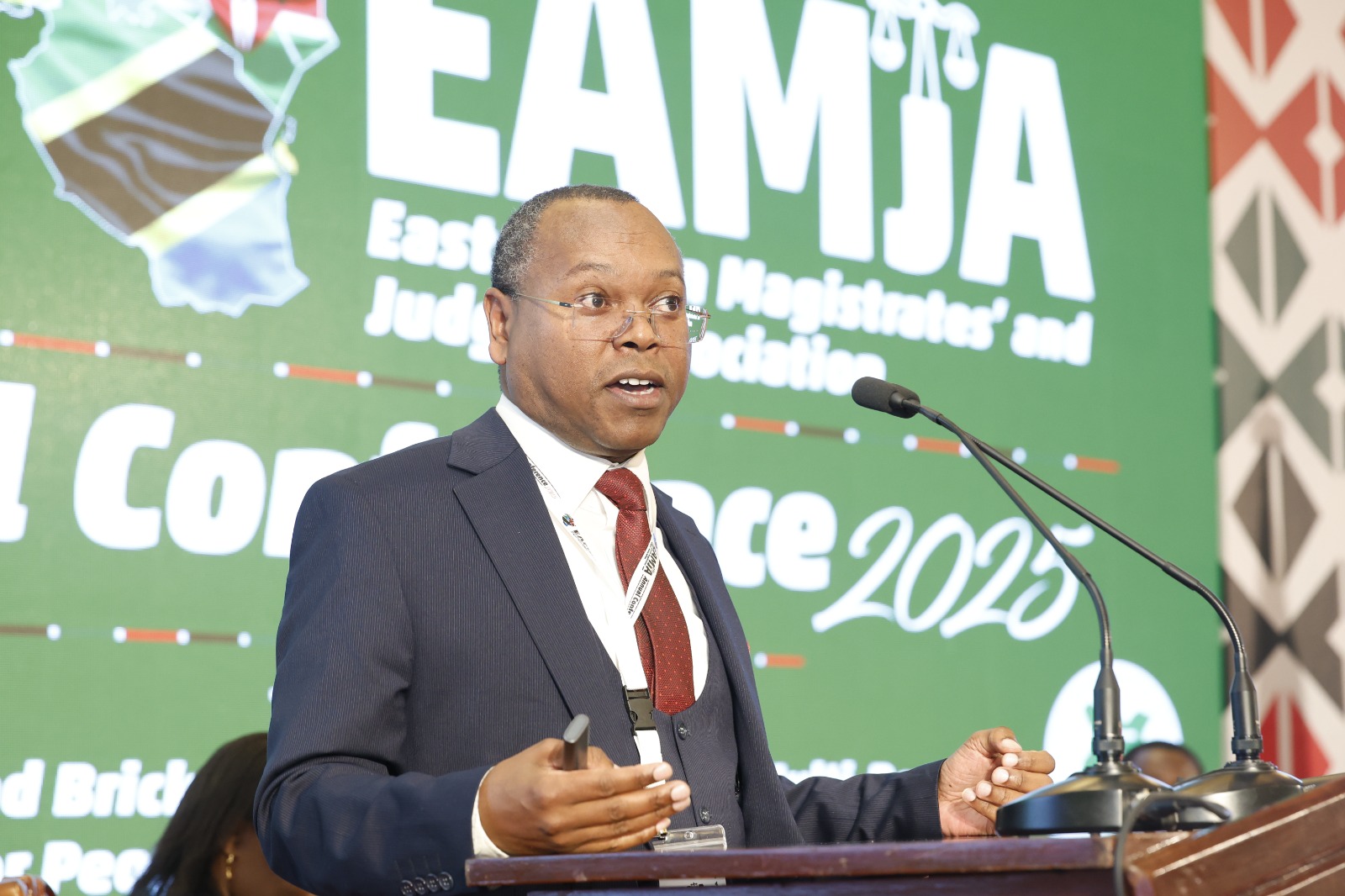
Panel discussions during the 22nd East Africa Magistrates and Judges Association (EAMJA) Annual Conference
The Future of Justice is Multi-door: From Courtrooms to Communities – The Case for Re-imagining and Mainstreaming AJS
Justice Prof. Joel Ngugi (Kenya) highlighted challenges and opportunities of the multi-door approach during a panel discussion on the “Future of Justice is Multi-door: From Courtrooms to Communities – The Case for Re-imagining and Mainstreaming AJS.”
The Judge who chairs the National Steering Committee on AJS called for the need to expand access to justice, reduce the justice gap, and the need to improve the quality of justice of the percentage of cases that go to Alternative Justice Systems.
During the discussions, other discussants who included Uganda’s Deputy Chief Justice Dr. Flavian Zeija, Rwanda’s Lady Justice Karihangabo Isabelle, & Tanzania’s Deputy Registrar Elimo Massawe, shared views on their respective countries, focusing on initiatives in AJS and community justice initiatives’.
The Future of Justice is Multi-door: Harnessing Mediation to Build Bridges and Speed up Justice
While deliberating on how to harness mediation to build bridges and speed up justice, Rwanda’s High Court Judge Harrison Mutabazi highlighted how Court Annexed Mediation (CAM) is transforming the country’s justice system.
He noted that CAM, which is primarily conducted by judges and judicial officers, has significantly reduced case backlogs and enhanced the efficiency of dispute resolution. Despite its progress, CAM still faces several challenges such as resistance from some lawyers, limited public awareness, and an insufficient number of trained mediators.
To address this, Rwanda has invested in the training and accreditation of mediators to strengthen the system’s capacity. Justice Mutabazi also underscored the role of mediation in criminal matters, particularly through plea bargaining processes that facilitate dialogue between victims and offenders.
Further, he emphasized that mediation is shaping the future of justice in Rwanda by fostering reconciliation and building bridges within communities. This he explained, complements the Abunzi system, Rwanda’s long-standing community-based dispute resolution mechanism that blends traditional and modern approaches to settle local conflicts.
During the session, Justice John Eudes Keitirima of the Uganda High Court explained that Uganda’s guiding legal principles require that justice be administered to all regardless of status, that justice should not be delayed, that appropriate compensation should be awarded to those wronged, and that reconciliation should be promoted.
He noted that it is precisely because of these principles that mediation offers the best pathway to resolving disputes—providing amicable solutions, easing court congestion, and ensuring more timely access to justice.
He explained that the Government and the Judiciary have developed legislative and administrative measures to strengthen mediation. Several courts are now piloting mediation programmes where retired judicial officers are appointed as mediators.
Once court pleadings are completed, registrars encourage parties to opt for mediation, with the Judiciary facilitating the entire process to ensure smoother resolution of disputes.
On the other hand, Justice Aisha Sinda revealed that Tanzania has made notable strides in strengthening its mediation framework, including the introduction of CAM Guidelines in 2024, which established common mediation rules across the Judiciary.
However, challenges persist, particularly in the enforcement of private mediation agreements. The Judiciary has integrated technology to support online mediation and introduced tools to assist persons with hearing impairments, enhancing inclusivity in the mediation process. Despite these advances, many advocates are still not fully informed or trained in mediation.
There is a growing need to expand public awareness of both CAM and private mediation as essential components of Alternative Dispute Resolution (ADR). Justice Caroline Kendagor of Kenya’s High Court observed that Kenya shares similar experiences and objectives regarding CAM.
In Kenya, mediation has been fully integrated into the Social Transformation through Access to Justice (STAJ) programme, and CAM is mandatory with a supporting legal framework and established mediation rules. She noted that private mediation outcomes can be adopted or enforced by the courts. She also referenced the ongoing National ADR Policy and Dispute Resolution Bill currently before the National Assembly.
Looking ahead, she emphasized the need to expand CAM, foster continuous dialogue between the Bar and the Bench through regular Court Users Committee (CUC) meetings, and explore the use of AI to match cases with the most suitable mediators. Kenya’s CAM programme, initially implemented in family and commercial matters at the High Court, has now been rolled out to all High Courts across the country.
The Principal Magistrate Josephine Nyatuga Maragia shared case studies illustrating the importance of tailoring Court Annexed Mediation to make it more relatable and accessible to the communities it serves.
She challenged participants to adapt ADR and mediation processes to local contexts, noting that this enhances acceptance and effectiveness. She further emphasized the need to consider the emotional dimensions of disputes, as these often play a critical role in achieving meaningful and lasting resolutions.
The Future of Justice is Multi-door: Small Claims Courts-Bringing Justice Closer to the People
Further, the panelists discussed the operations of Small Claims Courts in their respective countries under the theme “Small Claims Courts – Bringing Justice Closer to the People,” on the third day of the 22nd East Africa Magistrates and Judges Association (EAMJA) Annual Conference in Nairobi.
The discussion focused on the role of these courts within the various East African legal systems and their jurisdiction. The panelists highlighted the advantages of Small Claims Courts, emphasizing simplified procedures, speedy case resolution, cost-effectiveness, and increased accessibility compared to ordinary courts.
Emerging Digital Technology and its Impact on Judiciary Work
Mr Evans Ikua, an ICT Consultant with ITU, presented on emerging digital technologies and their impact on judicial work, particularly in enhancing efficiency. He discussed the adoption of technology in the dispensation of justice, outlining its benefits while also highlighting challenges such as data protection.
He explored the role of Artificial Intelligence in judicial processes, noting its potential to ease the work of judicial officers and reduce case backlogs, while cautioning that users must verify the accuracy of AI-generated outputs. He emphasized the need to harmonize digital laws across the EAC and to strengthen capacity-building efforts for judicial officers.
In addition, he encouraged the digitization of case management in East African countries and the adoption of digital signatures, among others. The session was moderated by Hon. Nabwike Mbaba, Magistrate, Tanzania.
Final or Reviewable? Binding or Bridging? The Legal Status of AJS and Mediation Outcomes.
Designing for Dignity and Human Rights: The Role of AJS in Protecting Human Rights in East Africa
Custom, Constitution, and Community: The Balancing Role of the Judge in a People-centered System – A Socratic Dialogue
Other panels that made significant contributions to the conference examined several key issues, including the legal status of AJS and mediation outcomes, The role of AJS in protecting human rights in East Africa and the balancing role of the judge in a people-centered system.
They discussed whether mediation outcomes should be considered final or reviewable, and whether they function as binding decisions or as bridging, relationship-focused agreements. In addition, discussants who are drawn from across the East Africa explored the role of AJS in protecting human rights in the region.
They interrogated the judge’s balancing role in a people-centered system, particularly in relation to custom, the Constitution, and community expectations. The panelist considered how multi-door justice approaches require judges and judicial officers to assume new responsibilities and move beyond the traditional “ivory tower” posture. These evolving roles include reconciling competing norms; serving as guardians of rights; acting as bridge-builders and connectors among justice actors; and promoting both AJS and ADR within the justice ecosystem.
Ends/…